
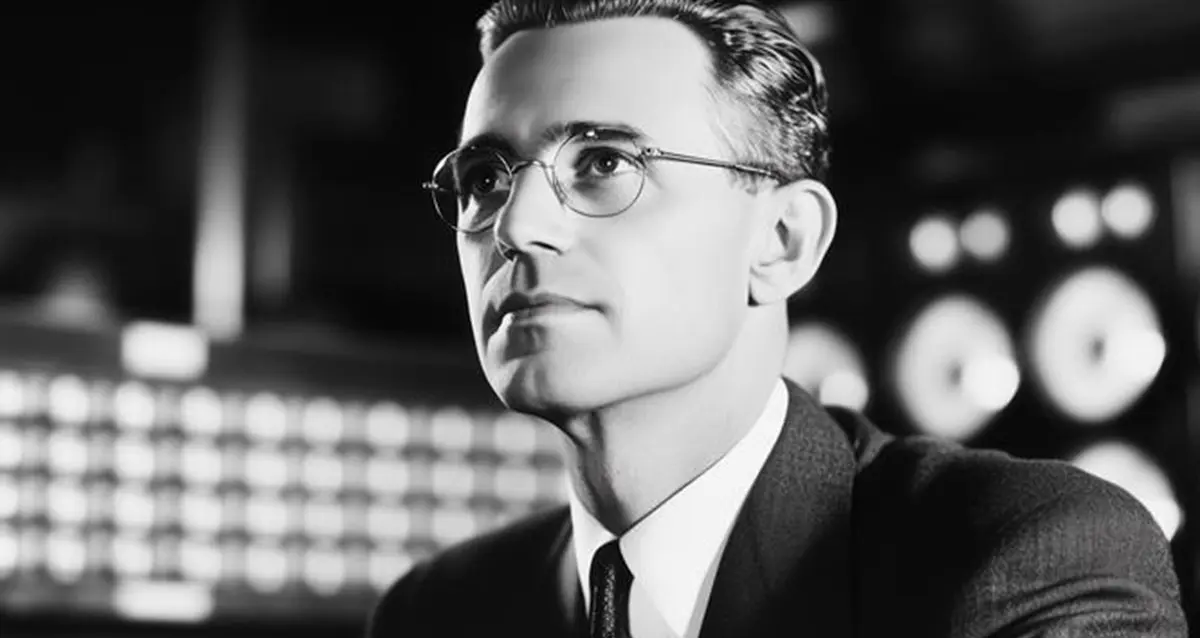
“We know the past but cannot control it. We control the future but cannot know it.”
~ Claude Shannon ~
1916 – 2001
Claude Elwood Shannon was an American mathematician, electrical engineer and cryptographer. He was born in 1916 in Gaylord, Michigan. His father was a business man and later a judge of probate and his mother was a language teacher. He was said to be inspired by Thomas Edison, who he later came to know was one of his relatives.[1] In 1949 he married his second wife, Mary Elizabeth Moore (Betty), who was a numerical analyst at Bell Labs. They had three sons and one daughter; Robert, James, Andrew Moore, and Margarita.[2] Betty was a mathematician and the main research collaborator of Shannon. Betty inspired and assisted Claude in building some of his most famous inventions. She is said to be an unsung hero.[3]
In 1936, after receiving BS degrees in mathematics and electrical engineering from the University of Michigan, he entered MIT as a graduate student. As a part-time job, he worked on Professor Vannevar Bush’s differential analyzer. His master’s thesis, A Symbolic Analysis of Relay and Switching Circuits, used Boolean algebra, in which problems are solved by manipulating two symbols, 1 and 0, to establish the theoretical underpinnings of digital circuits. This work was the beginning of modern switching theory. Harvard University Professor Howard Gardner called it “possibly the most important, and also the most famous, master’s thesis of the century.” In 1940, he received a Master of Science degree in electrical engineering and a PhD in mathematics from MIT. Upon graduation, he became a research fellow at the Institute for Advanced Study in Princeton, New Jersey, and joined Bell Laboratories in New Jersey in 1941.[4]
In the 1940s, Claude Shannon proved mathematically that if all of the requirements of One-Time Pad encryption keys are met, (1: the key must be truly random, 2: the key must be as large as the message it is encoding, 3: the key may never be reused in whole or part, and 3: the key must be kept secret), then it is uncrackable. Shannon called it “perfect secrecy” and further stated in the Bell System Technical Journal in 1949, “If properly used, One-Time Pads are secure in this sense even against adversaries with infinite computational power.” This report was initially issued on September 1 1945, as a classified document titled A Mathematical Theory of Cryptography, Memorandum MM 45-110-02, and was formally published in 1949, retitled Communication Theory of Secret Systems, in Bell System Technical Journal, 28 (1949) 656–715. This paper, discussing cryptography from the viewpoint of information theory, contained proof that all theoretically unbreakable ciphers must have the same requirements as the One-Time Pad.[5]
Claude Shannon’s quote, “The question of what defines a random sequence is at the heart of information theory”, encapsulates the fundamental concern of the field of information theory. When studying the transmission and processing of information, it is crucial to understand the concept of randomness. Shannon recognized that randomness plays a significant role in the creation, storage, and transmission of information. By unraveling the nature of random sequences, those characterized by unpredictability and lack of pattern, information theorists can better grasp the essential properties of data and devise efficient methods to encode, compress, and transmit it. Shannon’s insight highlights how unraveling the mysteries of randomness brings us closer to comprehending the underlying principles governing information, thereby further advancing our knowledge and capabilities in the digital age.
During WWII, Dr. Shannon, already a notable cryptographer, worked on secrecy systems at Bell Labs. His team’s work on anti-aircraft devices that observe enemy planes or missiles and calculate the aim of a counter missile, became crucial when German rockets were used in the blitz of England. His 1949 paper entitled Communication Theory of Secrecy Systems is generally credited with transforming cryptography from an art to a science.[6]
Shannon played a crucial role in developing secure communication systems, and contributed to the design of the Bell Labs cipher machine, SIGSALY, which was used by the United States and its allies during the war to encode sensitive military communications. The SIGSALY was a digital speech encryption system that went into service in 1943, just before the invasion of Italy and was decommissioned in 1946. It was used for confidential talks between British Prime Minister Winston Churchill and US President Roosevelt. It was the first and only encryption system to use One-Time Pad encryption.[7]
Among his many notable published works, Shannon is most known for the landmark paper, A Mathematical Theory of Communication, which he published in 1948. After the publishing of this document, he came to be forever known as the “Father of Information Theory”. This document provided the concepts, insights and mathematical formulations that now form the basis for modern communications technology. Shannon once said “I wanted to work on information and the measurement of information.” These works introduced the concept of information entropy and set the stage for the quantification of information and the development of coding theory. This paper became the foundation for modern data compression, error correction, and cryptography. It is commonly believed that many of his discoveries enabled the information age.
In his paper, he showed how data could be “compressed” before transmission and how virtually error-free communication could be achieved. The concepts Shannon developed in his paper are at the heart of today’s digital information technology. Virtually all electronic devices that we enjoy today were either derived from Shannon’s discoveries, or were inspired by them. Imagine a world without CDs, DVDs, cell phones, fax machines, modems, computer networks, hard drives, memory chips, encryption schemes, MP3 music, optical communication, high-definition television…
Shannon came up with a unifying, general theory of communication. It didn’t matter whether you transmitted signals using a copper wire, an optical fiber, or a parabolic dish. It didn’t matter if you were transmitting text, voice, or images. Shannon envisioned communication in abstract, mathematical terms, describing a concept of “information”, meant for communication engineers and proposed a precise way to quantify it. According to him, the information content of any kind of message could be measured in binary digits, or just “bits”, a name suggested by a colleague at Bell Labs. Shannon took the bit as the fundamental unit in information theory. It was the first time that the term bit appeared in print.[8]
Another revolutionary discovery contained in this paper, was that in contrast to what was commonly believed, engineers could in fact overcome their worst enemy, “noise”, or in technical terms transmission errors. Noise is anything that disturbs communication. It can be an electric signal in a telephone wire that causes crosstalk in an adjacent wire, thunderstorm static that perturbs TV signals distorting the image on the screen, or a failure in network equipment that corrupts internet data.[9]
It appears that Shannon approached research with a sense of curiosity, humor, and fun. Co-workers would often see him unicycling around the halls of Bell Labs and juggling any number of unusual objects. His later work included creating a chess playing machine and an electronic mouse that could work its way out of a maze. Perhaps these inventions were the first glimpses of artificial intelligence, in action. His ability to look at things in a transcendent way and at the same time with an approach of practicality, seemed to go beyond many of his contemporary colleagues. Many of his inspirations have become the catalyst that has inspired generations of computer scientists.
Dr. Marvin Minsky of MIT, who as a young theorist worked closely with Dr. Shannon, was struck by his enthusiasm and enterprise. “Whatever came up, he engaged it with joy, and he attacked it with some surprising resource — which might be some new kind of technical concept or a hammer and saw with some scraps of wood,” Dr. Minsky said. “For him, the harder a problem might seem, the better the chance to find something new.”
While Shannon worked in a field for which no Nobel prize is offered, his work was richly rewarded by honors including the National Medal of Science (1966) and honorary degree from Yale (1954), Michigan (1961), Princeton (1962), Edinburgh (1964), Pittsburgh (1964), Northwestern (1970), Oxford (1978), East Anglia (1982), Carnegie-Mellon (1984), Tufts (1987), and the University of Pennsylvania (1991). He was also the first recipient of the Harvey Prize (1972), the Kyoto Prize (1985), and the Shannon Award (1973). The last of these awards, named in his honor, is given by the Information Theory Society of the Institute of Electrical and Electronics Engineers (IEEE) and remains the highest possible honor in the community of researchers dedicated to the field that he invented. His Collected Papers, published in 1993, contains 127 publications on topics ranging from communications to computing, and juggling to mind reading machines.
Shannon died on February 24, 2001, at the age of 84, in Medford, Massachusetts, after a long fight with Alzheimer’s disease.[10]
[1] thefamouspeople.com/profiles/claude-shannon-8078.php
[2] scienceworld.wolfram.com/biography/Shannon.html
[3] “Betty Shannon, Unsung Mathematical Genius”. Scientific American Blog Network. Retrieved 2017-07-26.
[4] news.mit.edu/2001/Shannon
[5] historyofinformation.com/detail.php?id=1806
[6] news.mit.edu/2001/Shannon
[7] discoveryuk.com/mysteries/what-was-sigsaly-and-how-did-it-help-win-wwii/
[8] M. Mitchell Waldrop, The Dream Machine: J. C. R. Lickliderand the Revolution That Made Computing Personal, Penguin Books, 2001, p. 81. (An article in the September 1952 issue of Scientific American said about the term: “It is almost certain that ‘bit’ will become common parlance in the field of information, as ‘horsepower’ is in the motor field.”).
[9] The Essential Message: Claude Shannon and the Making of Information Theory. By Erico Marui Guizzo, B.S., Electrical Engineering University of Sao Paulo, Brazil, 1999.
[10] itsoc.org/about/shannon